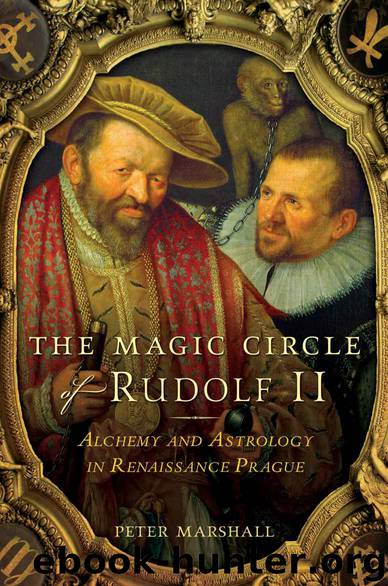
The Magic Circle of Rudolf II by Peter Marshall
Author:Peter Marshall [Marshall, Peter]
Language: eng
Format: azw3, epub
Publisher: Bloomsbury Publishing Plc
Published: 2009-05-26T04:00:00+00:00
Michael Maier in Atalanta fugiens (1618) wonderfully combines art, music and poetry. Wind here carries in his belly a baby who is said to be the future Philosopher’s Stone
Maier’s most famous and imaginative work, however, was Atalanta fugiens, hoc est, Emblemata nove de secretis naturae chymica (‘Atalanta fleeing: that is, new alchemical emblems of the secrets of nature’). It was published in 1618 with superb engravings by Matthew Merian. The title was inspired by Ovid’s tale of Hippomenes who chases Atalanta and ravishes her in a temple, whereupon they are both turned into lions. In alchemical terms, it shows the rivalry between Sol and Luna, Sulphur and Mercury, who eventually join in a chemical wedding to produce the Philosopher’s Stone. Maier’s work intertwines images, music, poetry and epigrams to inspire the Hermetic seeker. The first emblem, for instance, depicts a naked man with smoke billowing from his head and arms – the Wind – with a baby visible in his stomach – the future Philosopher’s Stone. The accompanying text states: ‘The wind has carried it in its belly’, probably meaning that Mercury (the wind) in its volatile form carries Sulphur (the infant).10
In this way, Atalanta fugiens uses symbols to show that the alchemical process and the search for the Philosopher’s Stone involves a gradual realisation of truth. As visual representations of abstract thought, the emblems work on many levels: literal, figurative and allegorical. The fifty or so musical fugues in the text are to be sung and intended to help create a favourable atmosphere in the laboratory. Atalanta fugiens offers a marvellous summary of Renaissance alchemy with its unique combination of practical experiment and spiritual understanding, and demonstrates how the arts and sciences can combine to great effect. The whole could be seen, read, sung and contemplated with exquisite pleasure.
Maier became an important figure in the Rosicrucian Movement, which tried to bring about moral and social reform through Hermetic enlightenment. He defended their ideals in his Verum inventum (1619). On Rudolf’s death in 1612, he visited Holland and then travelled to England where he met Sir William Paddy, the personal physician of King James I, the future father-in-law of the King of Bohemia. He may well have acted as a spy and ambassador. It was in London that he published his first book Arcana arcanissima. During his stay in England he also contacted Robert Fludd, author of The History of the Macrocosm and Microcosm, with whom he shared the same publisher in de Bry of Oppenheimer and similar Rosicrucian ideals. Maier died during the siege of Magdeburg in 1622 at the beginning of the Thirty Years’ War. In many ways, Maier’s work best sums up the unique combination of art, science, philosophy and religion which prevailed in Rudolfine Prague.
*
Another one-time Prague alchemist remembered as much for his magnificent illustrations as for his work is Heinrich Khunrath. Born in Leipzig in 1560, Khunrath studied in Basle and, given his wide range of intellectual interests, he aptly called himself a ‘Doctor of this and that medicine’.
Download
The Magic Circle of Rudolf II by Peter Marshall.epub
This site does not store any files on its server. We only index and link to content provided by other sites. Please contact the content providers to delete copyright contents if any and email us, we'll remove relevant links or contents immediately.
Fanny Burney by Claire Harman(26605)
Empire of the Sikhs by Patwant Singh(23089)
Out of India by Michael Foss(16856)
Leonardo da Vinci by Walter Isaacson(13339)
Small Great Things by Jodi Picoult(7148)
The Six Wives Of Henry VIII (WOMEN IN HISTORY) by Fraser Antonia(5518)
The Wind in My Hair by Masih Alinejad(5100)
A Higher Loyalty: Truth, Lies, and Leadership by James Comey(4965)
The Crown by Robert Lacey(4818)
The Lonely City by Olivia Laing(4804)
Millionaire: The Philanderer, Gambler, and Duelist Who Invented Modern Finance by Janet Gleeson(4481)
The Iron Duke by The Iron Duke(4364)
Papillon (English) by Henri Charrière(4277)
Sticky Fingers by Joe Hagan(4204)
Joan of Arc by Mary Gordon(4116)
Alive: The Story of the Andes Survivors by Piers Paul Read(4035)
Stalin by Stephen Kotkin(3971)
Aleister Crowley: The Biography by Tobias Churton(3642)
Ants Among Elephants by Sujatha Gidla(3468)
